
Three Days with My People: Dispatches from BIPOC PoP 2026

Every year I say the same thing on the drive home from BIPOC PoP: "That was the best one yet." And every year I mean it.
Dr. Frederick Luis Aldama's annual gathering of Blerds, Latinerds, scholars, librarians, and comics creators returned to UT Austin March 5-7, 2026, and once again it delivered something I genuinely cannot find anywhere else. Not at ALA. Not at a fan convention. Not at a symposium. BIPOC PoP is the rare space where a NASA astrophysicist, a Tejano singer, a public librarian, and a lucha libre performance artist can share a hallway and realize they are all doing the same work from different angles.
I came as a bilingual librarian with a youth services background. I left, as I always do, with a reading list that will take me the rest of the year to get through, a notebook full of ideas I need to share with my teens, and a feeling that I had been among exactly the right people.
Day One: The Craft of Getting In the Room
The conference opened with cartoonist J. Gonzo, author of La Mano de Destino, walking a room full of aspiring creators through the anatomy of a graphic novel pitch package. His advice was specific and practical, the kind you rarely hear. Send a pitch package as a PDF. Lead with what the book is about, which he was careful to distinguish from what the plot is. One is what happens; the other is why you made it. Include character sketches, three to eight sample pages, and four read-alikes from existing published work. Tell the editor where your book fits and why it still has something new to offer. Follow up once after four to six weeks, then let it go. Be professional, not a problem child.
As a librarian, I took notes for a different reason. I am constantly helping young people articulate why a story matters to them, not just what happens in it. J. Gonzo's framework is a gift I am going to use with every teen who tells me they want to make a comic someday.
Jose Pimienta, whose Mexicali trilogy spans Suncatcher, Twin Cities, and Half Way to Somewhere, led the next workshop with a deceptively simple exercise: pick a location, inside or outside, and fill it with specific details. Not a coffee shop. A grab-and-go counter with bad lighting and a regulars jar next to the register. The point is that a setting drawn with specificity becomes a character. It tells us who lives there and who doesn't. It does narrative work before a single word of dialogue runs. I watched people in that room start sketching. I started sketching too.
The afternoon held two of the day's most emotionally resonant moments. Illustrator and creator Jiba Molei Anderson offered a booktalk memorial for his collaborator La Morris Richmond, who passed away in January. He moved through La Morris's body of work chronologically, and with each title he shared a reflection from someone who had worked with him. It was grief turned into celebration, which is, when you think about it, what the best comics always do.

The day closed with a fireside chat between Paloma Martínez-Cruz and Veronique Medrano, two artists who both pushed back, in their own ways, against being put in a single box. Paloma, a professor, poet, and activist, talked about the Taco Reparations Brigade, a lucha libre performance art project that targets culturally clueless taco shops in Columbus, Ohio. Veronique, a Tejano singer, archivist of the Freddie Fender archives, and comics writer, performed a verse from her song Que Hueva, written the day she heard about the overturning of Roe v. Wade. Then she connected that same anger to Dragonthrall, a comics story shaped by the daily anxiety of living as a DACA recipient. Both women were clear: being multidisciplinary is not a hobby. It is a refusal to be reduced.
Day Two: Who Gets to Be Monstrous?
The second morning opened with a panel I want to cite in every collection development conversation I have for the next decade. Julia Brown examined The Wizard of Oz and The Wiz side by side to show how women who refuse the male gaze are consistently coded as villains. Kiana Murphy read that same logic through recent comics, including Killadelphia and Eve, tracing how Black children are forced to absorb or become the monstrous as a legacy of chattel slavery. It was sharp, uncomfortable, necessary scholarship.

Later in the day, comics scholars Dr. Julian Chambliss, Kevin Garcia, and Jiba Molei Anderson brought the archival work. Kevin's database of Latinx representation in Golden Age comics is going to be a resource I use constantly, both for collection decisions and for the reality check it offers: racist depictions ran alongside the work of Latino creators whose names have been largely erased from comics history. That erasure is not an accident. The database is a corrective.
The day ended with a panel I almost did not catch in time. Dr. Roman Gomez, an astrophysicist at St. Mary's University who teaches a class on the physics of manga, explained that as the only Latino in most rooms he occupied during his education and career, his role models were not real scientists. They were Reed Richards and Bruce Wayne. And it was manga that first made him want to understand the universe. I am going to be thinking about that one for a long time.
Day Three: Librarians, Oral Histories, and the Long View
On the final morning, St. Mary's librarian Gabe Lopez and I led our own panel, “League of Librarians: Comics in the Stacks and in the Classroom.” We had a smaller room this year, which meant it felt more like a real conversation. We ended up in a long side discussion about graphic medicine, a subset of nonfiction comics that addresses health topics, from living with ADHD to cancer memoirs to HIV narratives. Gabe's point landed hard: these collections make even more sense when your institution has a nursing or medical program. Empathy can be taught. Comics can teach it.
The day's afternoon panels moved from Cathy Camper's account of the lowrider culture, astronomy, Mayan mythology, and Arabic and Indigenous word origins woven into the Lowriders in Space series, to Bahar Momeni's beautiful, necessary observation that women in Iran waited in lines around the block for fine undergarments even as the morality police cracked down, because self-care is resistance too.
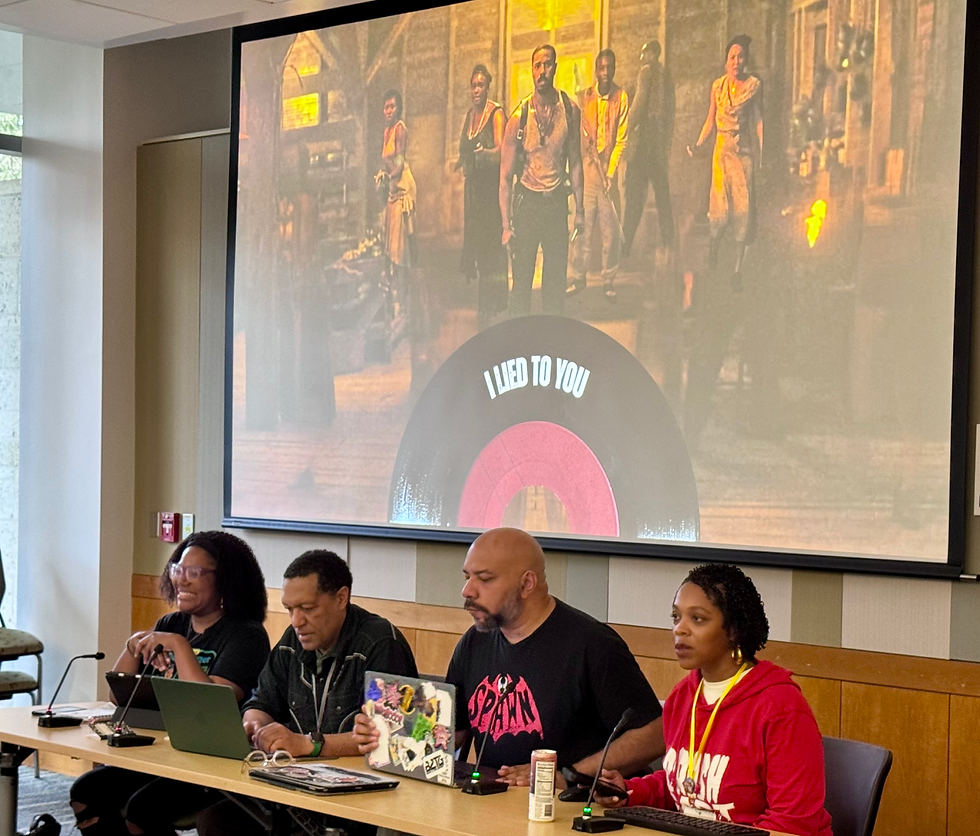
The conference closed with a panel on early Black comics strips, featuring John Jennings, Margarita Castroman Soto, Stanford Carpenter, and Henry Barajas. Dr. Carpenter's work on Jay Jackson's Bungleton Green and the Mystic Commandos was the revelation of the weekend for me. Jackson was imagining Black technological exceptionalism and Afrofuturism in the Pittsburgh Courier decades before Marvel published Black Panther. He was also illustrating for pulp science fiction magazines at the same time. The throughline has always been there. We just have not always known where to look.
I almost skipped that last panel because I was tired. I am so glad I did not.
There is a thing I say to other librarians and library students whenever I recommend BIPOC PoP: You will find your people here, even if you are not a scholar or a creator. Even if you came in through a corner store tienda and a spinner rack of comics. Even if your job title is nowhere on the program.
Last year I showed up a little nervous. This year I was home.
See you March 5-7 for BIPOC PoP 2027 !
Dan Johnson is the YA Editor of Latinx Pop Magazine and a bilingual librarian specializing in youth services, early literacy, and graphic novel collection development. He holds an MSLS with a focus in Youth Services from the University of North Texas.


Comments