
This Is the Way, Boricua: Finding Permission and Joy in the Boricuaverse at New York Comic Con
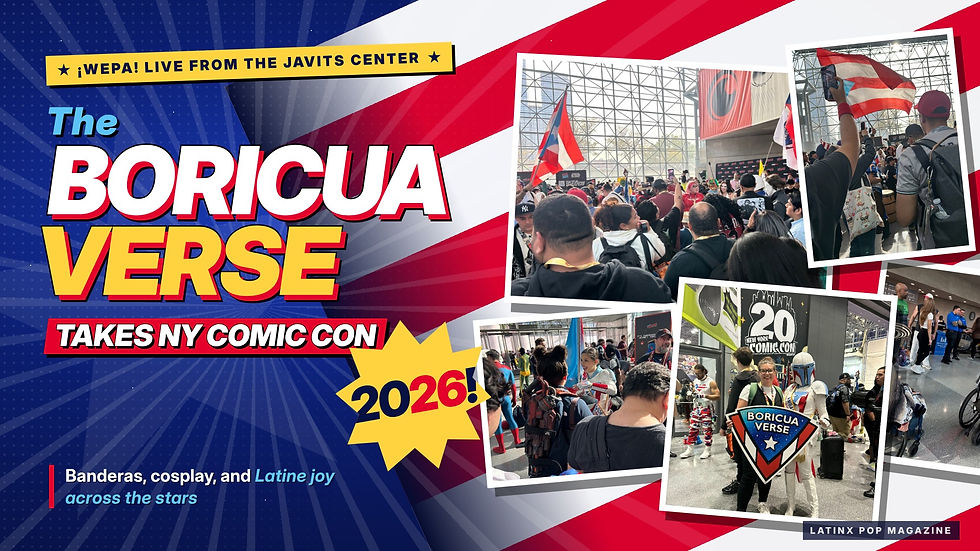
From October 8 to 11, 2026, I attended New York Comic Con for the first time. I am in the final stretch of my doctoral program in Literary Studies at the University of Wisconsin–Madison, where I am writing a dissertation on twenty-first-century Latinx popular culture. I am interested in how pop culture, especially mainstream media, serves as a site where Latines negotiate and reimagine their identity again and again. So I came to Comic Con intending to meet other Latines who love pop culture and to interview them for my research. I had my list of questions, my IRB approval, my microphone, and my informed-consent script. I knew not to overdetermine the research and to let conversations and events unfold as they would. What I could not have anticipated was how much I would be moved and changed in the process.
This is a story about how plans change, and how research gets better when we allow ourselves to experience joy. In future work, I hope to develop a robust analysis of what I recorded and what took place, situating it within the broader historical and political climate. Here, however, I want to testify to the thoughts and feelings I experienced as I gathered this material.
"What I could not have anticipated was how much I would be moved and changed in the process."

On Thursday, the first day of the con, I planned to get my bearings. New York Comic Con, held at Manhattan's Javits Center, is the largest pop culture event in the United States, with attendance of more than a quarter of a million in 2025. There was a lot to navigate (not to mention that this was my first true con; talk about diving in at the deep end!). I needed to scope out the space, figure out who was there and how they interacted, and, crucially, work out how I would approach people to recruit them for my research without profiling anyone.
Thankfully, that morning I spotted the Boricualorian, a Puerto Rican take on Star Wars' Mandalorian created by the cosplayer @floris_lilium. She is also one of the founders of the fan community Boricuaverse, which had popped up on my Instagram feed in the months leading up to the con. With a bio that reads "Celebrating Puerto Rican Pride in Cosplay & Geek Culture," the Boricuaverse is an extremely active group of Latinx fans based in the New York area, dedicated to bringing their cultural heritage into their fan practice. I was thrilled to find time to talk with Lili at length and interview her.
Later that day, a friend attending with me said there was a Dominican Mandalorian walking the floor. Even though I had already traded my professional clothes for a Spider-Man costume because I was "done working" for the day, I found him, too: a cosplayer known as @el_dominilorian. I chatted for a while with him and his mother (@theboricuamaul) about using our love for these characters as a way to think through our own Latinx heritage and identities. The next day, at a Spider-Man meetup, I met a man dressed as a Mexican-inflected Spider-Man and a woman cosplaying as Spider-Man 2099, Miguel O'Hara. I was elated to find so many people proudly and boldly displaying their cultural heritage through their fandoms.

For all my preparation, my methodology didn't account for one thing: that I'd be talking to Latino fans. I couldn't have anticipated how quickly I would be absorbed into the community the Boricuaverse has cultivated over the years.
New York Comic Con lets attendees host official fan meetups, and this year the Boricuaverse held its third. Scheduled for Saturday afternoon, the busiest stretch of the convention, it promised Puerto Ricans and plenty of other Latines a time to gather in celebration and fun. Over the first two days of the con, as I began interviewing people, every single person asked me the same thing: "Are you going to the Boricuaverse meetup on Saturday?" I had already planned to, but I was surprised to hear about it from, and be invited by, so many people.
What struck me most was how inclusive they were. I would explain that I planned to go, then sheepishly admit that I am not Puerto Rican but Cuban, and ask whether I would still be welcome. The response was always an emphatic "YES!" along with some version of the sentiment that the meetup was open to everyone. A few people told me, "It's [Cuban, Puerto Rican, etc.], all the same thing," and one person even said, "The flags are basically the same." Others explained that they were only half Puerto Rican, or not Puerto Rican at all but had Puerto Rican friends, or traced their roots to another country in the Latin American diaspora. Although the event prominently featured Puerto Rican culture and iconography (with la bandera flying EVERYWHERE), I and other Latinos felt welcome in this space and could share in its pride alongside our brothers and sisters.
"I would sheepishly admit that I am not Puerto Rican but Cuban, and ask whether I would still be welcome. The response was always an emphatic 'YES!'"
Many people I spoke with know that this kind of panethnic solidarity is not the norm in Latino communities. Several described moments in their lives, and even that day at the con, when they were told they weren't actually "Puerto Rican" because they weren't from the island, or didn't speak Spanish, or were too white or too dark, or didn't have the right hair, or were half something else.

As someone who has experienced this kind of racial and cultural impostor syndrome myself, I caught myself qualifying my own Cubanness. I grew up in South Carolina with no Hispanic community around me, I get nervous speaking Spanish, and I have been to Cuba only once, for a college course, and probably never will again. Many Latinos experience this impostor syndrome, especially as the Latino population in the United States grows far beyond easily quantifiable metrics of authenticity.
We have mixed heritage, we don't all speak Spanish, we aren't all shades of brown, we live all across the country and not just in a few well-known places, and we don't all have families who are proud of their heritage. In several interviews, as I tempered people's expectations of my own Latina identity, I was encouraged again and again to take pride in my history, ancestry, and heritage. Three different times, the person I was speaking with said, "It's in your blood," and a few times I was told, "You can't forget your history." I thought to myself, How do I remember my heritage for myself? How do I share a history no one told me? At the heart of those questions is one of permission: given my distance from my heritage, am I allowed to claim it?
"How do I share a history no one told me? At the heart of those questions is one of permission."

At the Boricuaverse meetup, I lingered at the edges, watching the onlookers as people danced and played music, and considered what the fan space affords those across the Latin American diaspora. As I watched people dressed as futuristic, intergalactic, magical, and fantastical beings wave their flags and dance to traditional songs, I realized that this space doesn't just permit people to express their identities anew; it allows Latinos to link their pasts to their futures, their bodies and blood to their imaginations, and their cultural icons to their present realities. Significantly, the fan space sets aside the compulsion to police one's authenticity. Instead, it encourages people to nurture the connections we have, and could have, with one another.
"The fan space sets aside the compulsion to police one's authenticity."
Nor are people unaware of the political realities Latinos face in this country. One cosplayer dressed as Spider-Man carried a sign with ICE crossed out, while another, in a Puerto Rican War Machine/Punisher mashup, had "PR NO SE VENDE" ("Puerto Rico is not for sale") painted on the back of their costume. Fan activism of this kind has drawn scholarly attention for years, notably from media scholar Henry Jenkins, and much of that work calls attention to how imagination and community link politics and fandom.
"What we want and need and must fight for is love and joy. And we need to feel that every once in a while."


Comments