
Drawing Cultura: A Conversation with Contributors to From Cocinas to Lucha Libre Ringsides
- Frederick Aldama
- Jan 1
- 9 min read
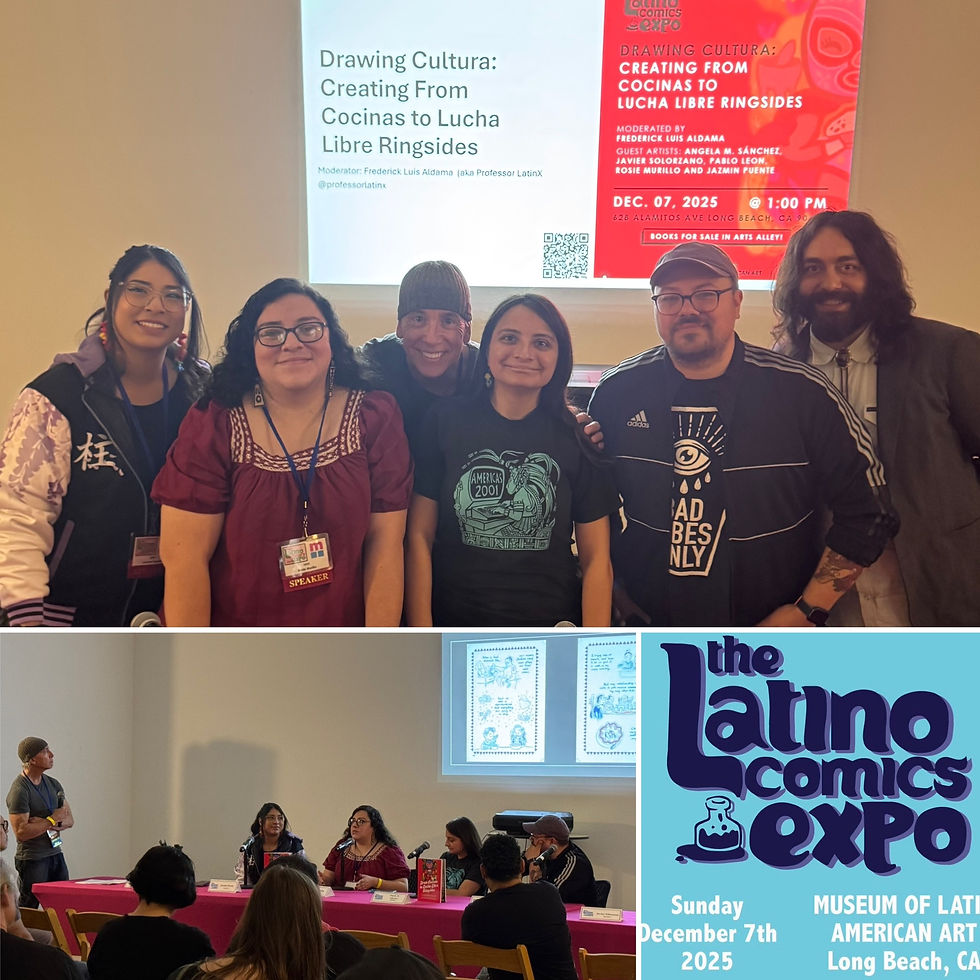
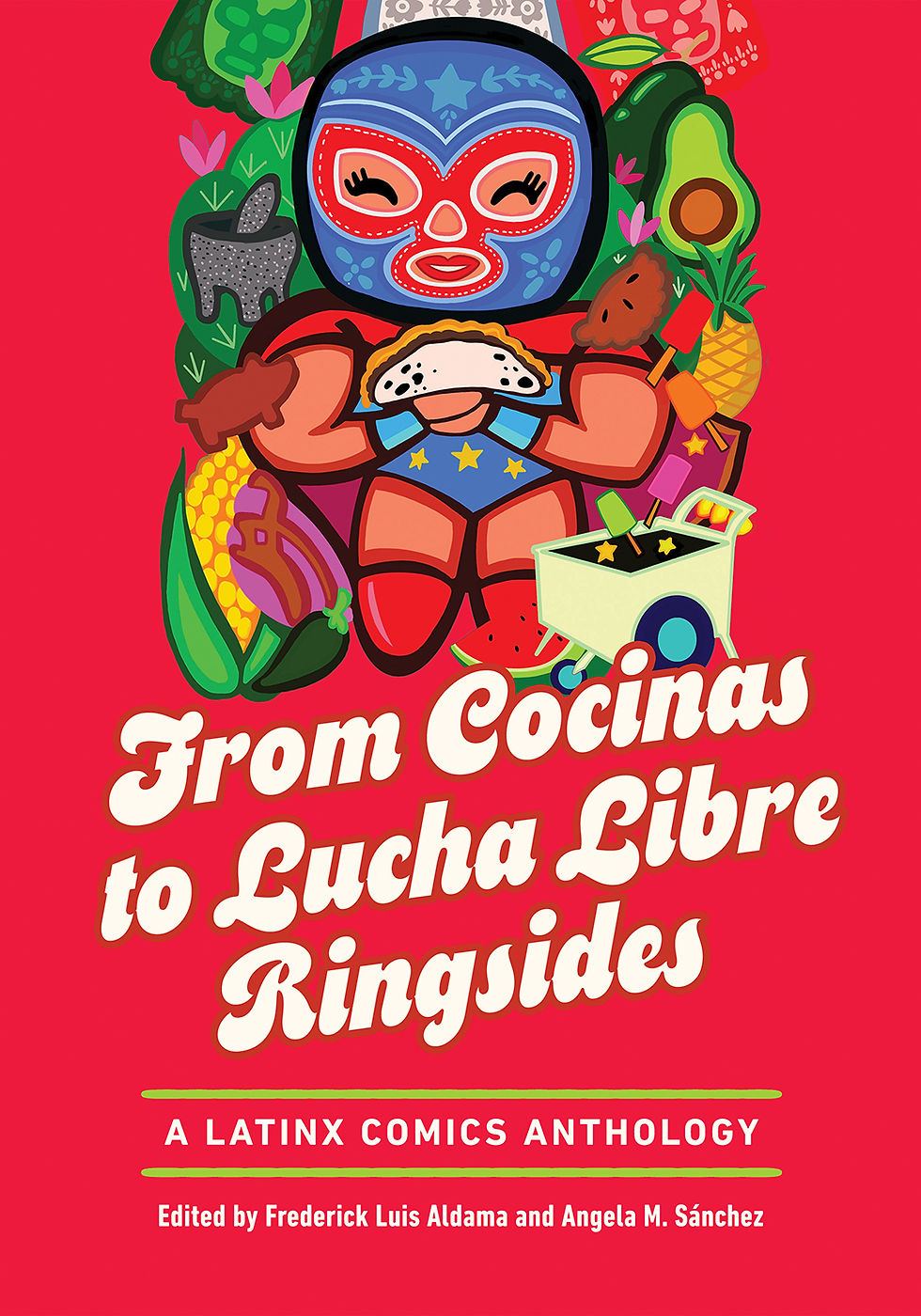
At Latino Comics Expo 2025, held at Long Beach's Museum of Latin American Art (MoLAA), five comic artists came together to talk with me and a crowd of LCX attendees about From Cocinas to Lucha Libre Ringsides: A Latinx Comics Anthology, the Latinographix anthology I co-edited with Angela M. Sánchez. The anthology braids stories of food and sports—la cocina and el ring, the kitchen table and the playing field—through the visual grammar of comics.
What follows captures the heart of that afternoon's conversation. I spoke with fellow co-editor Angela M. Sánchez about her comic "Nopal," Rosie Murillo about "Caldo de Pollo," Javier Solórzano about "Nuestra Lucha," Jazmin Puente about "I Dislike Soccer," and Pablo Leon about "The Beautiful Game," co-created with writer Julio Anta.
On the Anthology's Vision
Frederick Luis Aldama: Angela, as co-editor of this anthology, what gaps in Latinx comics representation were you hoping to fill with this collection?
Angela M. Sánchez: There's this little, short silent trauma that happens when the nopal spines move through the screen for the first time. You're like, here it is. What do I do with it? Do I chop it off? What do I make? And then this little flower blooms at the end. That moment—it can just be seen on the face. It's cute and silly if witnessed, but it also carries so much weight.
For people from within our culture, there's usually this old connection to food that we carry. You remember your first moves in the kitchen, the first time you helped your mom. But also for people not from this culture, stories like these serve as an initial introduction. I loved that we could include pieces that touched on things that weren't always warm and comforting—stories about food insecurity, for example. One story resonated with me because the author talked about having to put a bag of chips in a bowl to make it feel like there was more food. It's important to recognize all those difficult truths that exist alongside the celebration.
Angela M. Sánchez — "Nopal"

FLA: Your comic "Nopal" is so beautifully succinct—six panels that tell a complete story. It's choreographed and very concise. Can you share a little bit about how you arrived at that?
Angela: The phrase "tienes el nopal en la frente" came from a friend looking at me, and I was like, this is really right for me to make into a comic. It just kept spinning in my head. In terms of getting down to six panels, I just wanted to be concise. In comics, we often have to pare down stories. We have to make sure they communicate their ideas efficiently. Short can be powerful.
FLA: The color palette changes every panel. Can you walk us through your color choices?
Angela: The only color that was most intentional is the red background—that's when it becomes the most dramatic, when the knife comes out. So everything else needed to be a little more toned down in comparison. The yellow and green are there because we're cooking. The pink panel is meant to be bright and happy—that's the payoff. A lot of it is intuitive at this point. At a certain moment, you're making active choices, but it's also just happening. You become a master of your craft.

Rosie Murillo — "Caldo de Pollo"
FLA: "Caldo de Pollo" traces your evolving relationship with your mother's signature dish. Tell us about the personal story behind this comic.
Rosie Murillo: My mom is a great cook. She can make a wide variety of delicious meals. Growing up, her most common dish was Mexican chicken soup—caldo de pollo. But as a kid, I was really into chicken nuggets. I wasn't a fan of the soup. There was one time I just refused to eat it, and my mom was like, okay, you're going to sit at the table until you finish.
But when we were sick, she would make it, and it was like the sweetest thing. It has healing properties—not just physically, but emotionally. Each sip was a reassurance that everything was going to be okay. It became a source of comfort, part of the healing process. That's what I wanted to capture: my relationship with caldo de pollo remains unmatched by any other dish. And yes—chicken nuggets are overrated anyway.
FLA: Tell us about your visual process and style choices.
Rosie: The style is loosely based on the bowls we would usually eat the soup from. We have these bowls with little designs around the rims—that's where the border design came from. It was done in Procreate. For the images, I actually had to put myself in my mom's shoes. I made the caldo myself to really appreciate it, to capture it authentically. Going through that process made the work more meaningful. And yes, I do feel closer to my mom after making this comic.

Javier Solórzano — "Nuestra Lucha"
FLA: "Nuestra Lucha" interweaves lucha libre with scenes of a taquero at work. What inspired this parallel structure?
Javier Solórzano: This story started back when I was playing with the parallels between lucha libre and working-class struggle. For those in the working class, lucha libre and pro wrestling are the stories we tell about ourselves and our people—about our trials, our tribulations. When the anthology call came, I knew this was the chance to explore that.
Especially when I realized that food was involved. At many shows, wrestling shows, you see the wrestler setting up the ring at the same time as the señora setting up her food stand. It's completely parallel—that working-class attitude of: we're gonna make the best of this, we're gonna have fun, we're gonna do our best. Food and sports are connected for me in that way.
FLA: The diagonal panel layouts create incredible energy. How did you approach page composition?
Javier: My first drafts were coming in at like twelve pages, so I had to condense. A lot of it came from studying how lucha libre comics use their layouts to tell stories. The zigzag panels are intentional—they remind you of how wrestlers bounce off the ropes. When you're watching a match, there's this sense of action, this energy. I wanted to capture that same feeling while also showing the rhythm of food preparation. It was also special because the four luchadores in the story are real local wrestlers who've supported me from day one. Being able to honor them in a medium they're not normally seen in—that meant everything.
FLA: The line "Life is a struggle. But like the luchador, together we can fight" closes your comic powerfully.
Javier: Even the name—lucha libre—means "free fight" or "free struggle." It echoes a fundamental truth for those in the working-class audience: life is a struggle. We work to survive a system that's uninterested in helping us at its best, and downright ready to harm us at its worst. But like the luchador, together, we can fight. That's the message I wanted to leave readers with.

Jazmin Puente — "I Dislike Soccer"
FLA: Your comic opens with "My name is Jazz! I dislike soccer. Let's get into it." That directness is refreshing. How did you find the voice for this story?
Jazmin Puente: This story explains why I'm personally not a big soccer fan, and it has nothing to do with the game itself. It has everything to do with my own personal experience. I used to love sports. I was very athletic, very much into it. But as the story shows, my father played a big part in erasing that love.
The story is about the trauma that comes from constant criticism, constant negativity—the very aggressive atmosphere and environment I grew up in. At the end, it's about my detachment not only from soccer but from my father himself. Because he made it very clear that soccer was more important to him than his family, more important than his kids, more important than me.
FLA: The color palette shifts dramatically throughout—from bright pinks to very dark tones. Can you talk about those visual choices?
Jazmin: Very intentional. I wanted to be clear about the feelings involved. It starts with the big love of soccer—playing with the neighborhood kids, lighthearted, hopeful. The bright colors show childhood innocence. Then it progressively gets bleaker as the different emotions get invoked. I even tried tennis to escape, but my father learned just enough to continue his criticism. No matter what I did, it wasn't ever good enough.
The colors get darker until the final scene, which is the darkest—the weight of that heavy conversation, that argument, the realization that he'd made his priorities very clear. The visual journey was meant to bring you into my world and show how it felt going through this experience.
FLA: What was it like creating this comic? Did it feel like a healing experience?
Jazmin: Overwhelming. You tell yourself it wasn't as bad, and then when you finally look back, you realize it was as bad as it felt. That's not something usually talked about with trauma. You're always diminishing it. Family tells you you're overreacting, you're too sensitive, you're being emotional. We don't talk about the real issue—the environment, the actions, and how they affect you.
Finding the strength in telling that story was the biggest eye-opener. We're told "it's family, you gotta forgive them." But at some point, you have to look at people who are telling you to your face that they don't care about you and take it at face value. Stop chasing people you have to beg for love from. That's not love.
What I loved about my journey—getting to college, meeting other artists—is discovering that you don't have to chase love. Love will come to you. It's okay to embrace that pain, to learn from it, to realize you can break the cycle. I was so much like my dad at one point. I took the liberty of looking at myself and realizing that's not who I want to be. If you take anything from my story: you're not alone. We can grow and learn from these experiences.

Pablo Leon — "The Beautiful Game"
FLA: Can you share your collaborative process with Julio Anta in shaping "The Beautiful Game"?
Pablo Leon: When you work so closely together, it becomes a melting of creative minds. It says Julio Anta as writer, and this is his story, but it's as much Pablo as it is Julio. A lot of us growing up, especially with the World Cup, we wanted to be soccer stars. Obviously that doesn't happen for most people.
With the 2022 World Cup, there was this ethical and moral dilemma about supporting the U.S.—a country that's actively attacking other countries, that designated Cuba for decades. And as we come to 2026 with the U.S. hosting, all these things are wrapped up globally. For Julio, that conflict—loving a sport while questioning what the national team represents—that tension is real.
FLA: The story traces Julio's journey from a Miami kid dreaming of the World Cup to an adult grappling with what it means to root for the U.S. How did you navigate that politically charged territory visually?
Pablo: The comic starts very warm, nostalgic—childhood dreams. Then as you move forward, it gets distorted, the colors shift to colder tones as we address U.S. intervention in Latin America, the policies, the history. There's frustration, and then eventually we move toward something that could be better.
FLA: The 2022 World Cup squad—with players whose families came from fifteen countries—becomes a symbol of a different American Dream. Are you offering a vision of what that could look like?
Pablo: The American Dream—is it even real? For me, it's more like: you plant your seeds where you are, you create more seats at the table for the future. The reality is we can do better. We should do better. The last panel shows unity, joy, a different vision—a different way of being in the world. It's not easy to hold these tensions, but I think it's the necessary conversation we need to have.
Closing Thoughts
FLA: What do you hope readers take away from this anthology and your contribution to it?
Jazmin: Break the cycle. Don't continue cycles of abuse. We can do better, we can learn. In our communities, unfortunately, a lot is tied into anger and how that's used to control people. But you can elevate people with love instead of hurt and pain. Break the cycle. And know you're not alone.
Rosie: Find moments that bring you comfort amongst the chaos. Be aware of how you can contribute—help your friends, help your community. But also take time to appreciate those around you.
Pablo: This anthology shows a bunch of different perspectives within the Latinx community—so many different types of foods, so many different types of sports, all connected to working-class experience. You can see the variety that exists in our larger community. That's the big takeaway: there's something for everybody in this book.
Javier: We're being deported by mass. ICE is singing songs in our neighborhoods, snatching our neighbors. We're not a monolith—we're very different from each other. But we have to stay together. Don't let them divide us with "Mexicans do this, Central Americans do that." Fascism isn't just coming from the government. It's coming from toxic masculinity, from private equity ruining our electricity, our water, our air. We cannot survive unless we stick together and fight back together. That entry point this book provides—seeing all the different kinds of Latinx representation—will hopefully let someone pick up something they wouldn't have otherwise. That's what anthologies are for.
Where to Find the Artists
Jazmin Puente: @SundryJazz
Rosie Murillo: @LilRosieArt
Pablo Leon: @artsypabster
Javier Solórzano: @luchacat
From Cocinas to Lucha Libre Ringsides: A Latinx Comics Anthology is available now.


Comments