
Difé! The House That Set Itself on Fire: A Review of Francesca Momplaisir's My Mother's House
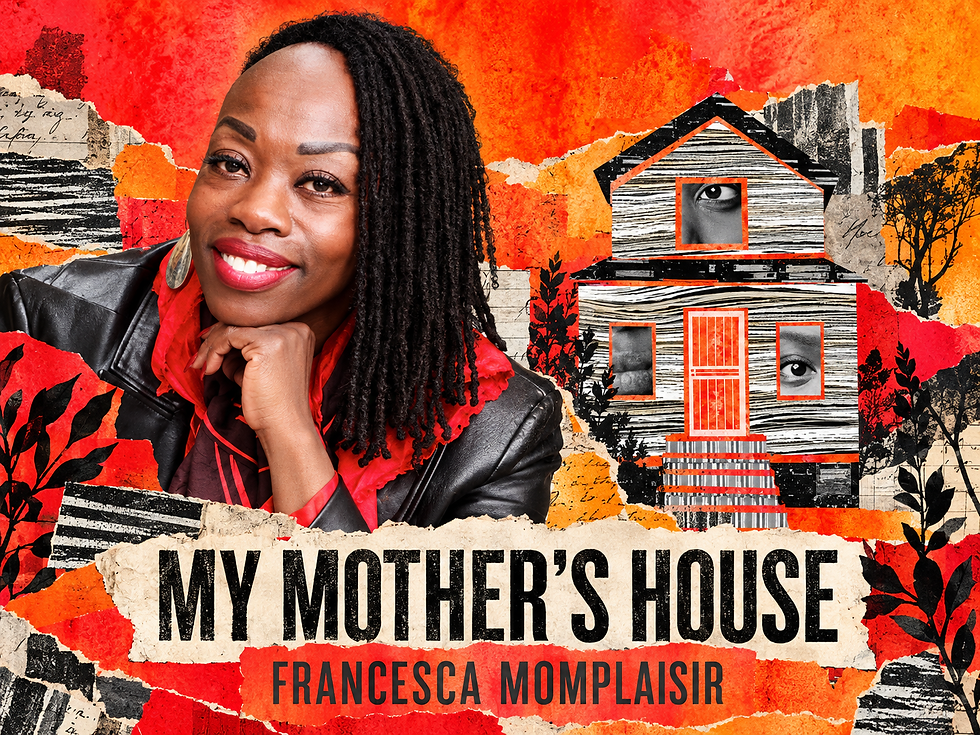
“The House screamed, ‘Fire!’ from every orifice. Difé! Melting windowpanes rolled down the aluminum siding, dripping polyurethane tears. Orange, blue, and yellow flames hollered their frustrations into the icicles along the struggling gutters. . . . House had had enough. Fed up with the burden of Its owner's absurd hoarding, inexcusable slovenliness, and abuse of power, It spontaneously combusted everywhere a power source sprouted unkempt. . . . The House blew it all up and burst into tears It had been holding back for decades.”
Francesca Momplaisir, My Mother's House
My Mother's House opens with the poetry and pain of a sacrificial fire: difé, Haitian Kreyòl for fire. The blaze reads less as an act of suicide than as an act of cleansing, meant to erase the stain of domestic trauma from a diasporic space. Through a Gothic horror lens, the novel explores how systemic containment, patriarchal violence, and the desperate search for sanctuary collide in a story of Haitian immigrants pursuing the “American Dream.”
This is no ordinary haunted house turning on its owners with malicious intent. The House is a complex character with emotion and agency, far more than a neglected, overstuffed building. Haitian-born literary scholar and novelist Francesca Momplaisir uses the House as an engine of pent-up frustration and silent grief, giving a voice to the voiceless. She sets the novel in the South Ozone Park of the 1980s and '90s, a Queens neighborhood shifting from its Italian American roots into a haven for Haitian immigrants, and builds a world where the promise of the American Dream quickly sours and turns deadly behind closed doors.
Human corruption infects and traumatizes the physical structure itself.
The story unfolds through three narrators: La Kay (the house); Sol, a victim of the horrors happening inside La Kay; and Lucien, the novel's central antagonist. La Kay serves as a Haitian community center and the hub of immigrant life in the neighborhood, hosting traditional Haitian dinners, Caribbean music, and gambling, a modern-day Club Borinquen. Lucien is at the center of it all, and he is no flat villain bent on evil. On the outside, he is charismatic and confident, a savior figure and liaison for the Haitian community, a shining example of the “Immigrant Success Story.” He is always there to lend his compatriots a hand, help with immigration matters, or loan a few dollars at a steep rate of interest. Beneath the shiny exterior, however, is a man clawing for possessions and power in the hope that they will secure his place in New York City and silence the voice inside him that nags: I am nothing. This hunger drives him to commit heinous acts, poisoning the lifeblood of La Kay and turning it into a site of confinement and exploitation. Momplaisir leaves us with a question: Where does sanctuary end and confinement begin when the very walls built to protect a vulnerable community become a site of tyranny?
At its core, My Mother's House flips the script on the stuffy haunted houses of eighteenth- and nineteenth-century Gothic fiction. Rather than repeat the classic trope of the malevolent house that corrupts an innocent family, Momplaisir turns it on its head: here, human corruption infects and traumatizes the physical structure itself. La Kay carries the same gothic dread as Daphne du Maurier's Rebecca, reimagining Manderley as a two-story house soaked in the collective grief of the Haitian diaspora rather than a distant English estate built on private secrets. Instead of leaning on Hollywood horror tropes, Momplaisir builds a claustrophobic tension closer to Bong Joon-ho's Parasite. On the surface, the home promises order and safety; underneath, it hides a sinister trap of exploitation and depravity. Where Parasite uses its house as a passive backdrop for class warfare, however, Momplaisir gives La Kay its own twisted moral agency.
Where does sanctuary end and confinement begin when the very walls built to protect a vulnerable community become a site of tyranny?
What makes La Kay's revolt so tragic is how deeply it is woven into the pop culture of the 1980s and '90s. The House is no cold, detached entity. It engages with the world inside and outside its doors. It develops an affinity for hip-hop, sways to Caribbean rhythms, and vibes to Michael Jackson and Whitney Houston spinning on old vinyl. By anchoring La Kay in the lived landscape of New York City, Momplaisir makes its decision to self-destruct, to burn itself to the ground rather than keep housing Lucien's atrocities, read as an agonized act of self-cleansing rather than a horror-movie gimmick.
On the surface, the home promises order and safety; underneath, it hides a sinister trap of exploitation and depravity.
That cleansing comes at a high narrative cost. Momplaisir's prose, poetic and lush, is also graphic and unrelenting in its depiction of sexual violence, abuse, and exploitation. At times the sheer magnitude of the trauma threatens to overwhelm the reader. Reprieve comes in the form of Sol, the novel's moral center. Her resilience and hope resonate through the noise, an emotional anchor that pushes the narrative forward. Through Sol, Momplaisir turns what could have been a catalog of suffering into a persistent, courageous movement toward survival and freedom.
It refuses to romanticize survival, demanding instead that we look at how race, migration, and male toxicity manifest behind closed doors.
My Mother's House deserves its place in the Haitian American canon, and in the wider canon of Caribbean American literature, as a contemporary telling of the immigrant experience. It refuses to romanticize survival, demanding instead that we look at how race, migration, and male toxicity manifest behind closed doors. Haitian immigrants in the United States face rampant racist attacks, and the termination of Temporary Protected Status (TPS) leaves Haitians undocumented and facing sudden deportation to a country gripped by widespread violence and economic collapse. In this moment, Momplaisir's voice is critically important. My Mother's House stands as a blueprint for how bold contemporary fiction can dismantle genre conventions and weaponize them in the service of social change.
Momplaisir isn't writing a ghost story of the past; she is shedding light on a present-day reality.
Author's Note
In 2025, the United Nations Integrated Office in Haiti (BINUH) verified 1,863 cases of sexual violence, more than 99 percent of them against women and children. The crisis has only deepened since. Humanitarian agencies recorded some 5,500 incidents of gender-based violence in the first six months of 2026 alone, and experts warn that these figures are badly underreported because of social stigma and fear of gang retaliation. Momplaisir isn't writing a ghost story of the past; she is shedding light on a present-day reality in which women and children remain targets of violence and exploitation. To support relief efforts, visit Partners In Health.


Comments