
Breaking Barriers: How Stephanie Beatriz's Rosa Diaz Revolutionized Latinx Representation
"Oh, I auditioned for that show, but I heard they were going ethnic."
Imagine sitting at a table with other women in the acting industry and hearing this, knowing you were the "ethnic hire". This was Stephanie Beatriz's reality when she landed the role of Rosa Diaz on Brooklyn Nine-Nine. She recounts this uncomfortable memory on the More Better podcast she co-hosts with Melissa Fumero.
Perhaps the woman meant to say, "I'm happy to see more representation on television"—at least, that's what we'd hope. But let's be honest: we know exactly what she meant. The casual dismissiveness, the othering wrapped in that word "ethnic," reveals how Hollywood still sees us as outsiders stealing "their" roles. The shock that a Latinx actress could win a major part speaks to a truth we all know too well—we remain the most underrepresented group in television and film.
And when we do appear? We're served up as the same tired stereotypes: the spicy Latina, the maid, the gang member's girlfriend. Always hyper-sexualized, rarely intelligent, forever existing in relation to someone else's story. I'm exhausted by it. Aren't you?
Rewriting the Script
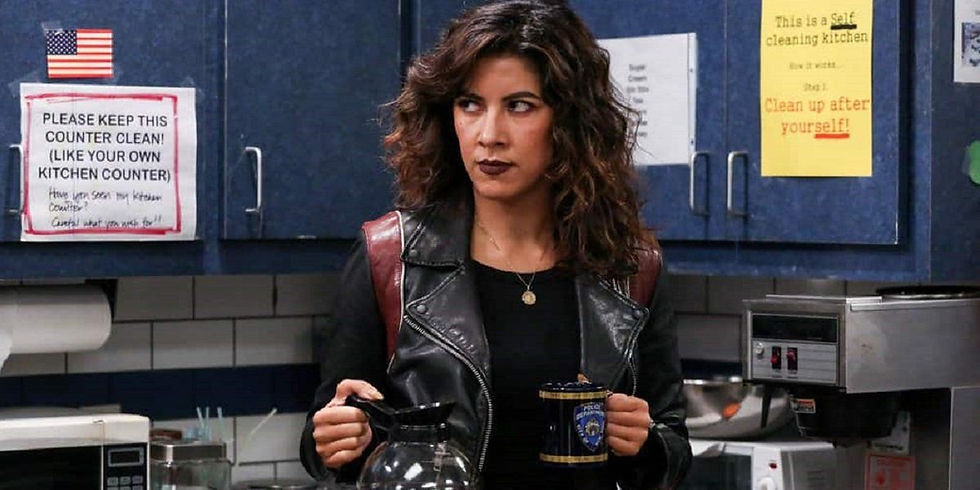
This is why Rosa Diaz matters—why she really matters. Beatriz didn't just break stereotypes; she obliterated them so thoroughly that you forget Rosa was originally written as Meghan, a "fiery redhead." The character we know rides motorcycles in leather jackets, solves crimes with stone-cold efficiency, and guards her personal life like state secrets. She's bisexual, complex, and completely uninterested in your expectations.
What strikes me most is how Beatriz crafted this character from day one. She initially auditioned for Amy Santiago (ultimately played by fellow Latina actress Melissa Fumero), the only character explicitly written as Latina. But after her screen test, they offered her Meghan—and Beatriz transformed her into Rosa Diaz. This wasn't luck; this was an actress claiming space and reshaping it entirely.
From the beginning, Beatriz infused Rosa with queerness—not as an afterthought or ratings grab, but as essential to who Rosa is. "There were clues in the script," she revealed in an interview. "Like early on, she says Tonya Harding was hot. There was always a joyful sexual tension with Gina Linetti." While some cried "queerbaiting", Rosa came out in the 99th episode. An end to the slow burn building all along. Those knowing glances and sly comments weren’t throwaways — Beatriz was playing the long game, and it paid off — not just because it was done right, but because it gave us the kind of representation we’d been waiting for.
The coming-out scene itself is a masterclass in authentic representation. When Beatriz saw the line "Mom, Dad, I'm bisexual", in the script, she was overwhelmed. "I felt like there was something wrong with me, and I felt like I wanted to scratch off my own skin when I felt those urges and feelings," she shared. "And there it was in a script that I was going to help bring to life."

Can we talk about how revolutionary this moment was? Here's a Latina actress who came out on Twitter herself in 2016, playing a Latina character coming out on network television, with writers who actually listened to her input. The intersectionality wasn't treated as a burden or a "very special episode"—it was handled with the care our stories deserve but rarely receive.
The intersectionality wasn't treated as a burden or a "very special episode"—it was handled with the care our stories deserve but rarely receive.
Beyond the Happy Ending
What I love most—and what some viewers completely missed—is how Rosa's story ends. While her colleagues pair off into neat heteronormative conclusions (marriages, babies, the works), Rosa stands alone and complete. She tells Amy she doesn't need a partner to be happy. She's whole on her own terms.
But here's where it gets even better: Rosa leaves the NYPD. During the Black Lives Matter protests, while other cop shows scrambled to stay relevant, Brooklyn Nine-Nine had Rosa quit the force to become a private investigator helping victims of police brutality. Think about that for a moment. A queer Latina character on a cop comedy makes the radical choice to work against the system rather than within it. That's not just character development—that's a political statement disguised as a sitcom plot.
Some called this ending disappointing. I call it revolutionary. Rosa doesn't get the traditional happy ending because she was never a traditional character. She gets something better: agency, purpose, and the freedom to define success on her own terms. Isn't that what we're all fighting for?
When Latino/a/x watch Brooklyn Nine-Nine, we don't see Rosa as the diversity hire or the token character. We see possibility. We see a character who won't soften her edges for comfort and who exists fully and unapologetically in her complexity. We see ourselves—not as Hollywood imagines us, but as we actually are.
"At this particular point in history we're in, it is important to have those voices whose stories [are] their own," Beatriz emphasizes. "The more avenues we can get into to tell stories that are smart, funny, dramatic, daring, and reflective of the human experience, the better."
But let's push further—this isn't just about having more Latinx characters on screen. It's about who gets to shape those characters. Beatriz didn't just play Rosa; she fought for her, molded her, made her real. She took a role meant for a redhead named Meghan and created an icon for queer Latinas everywhere. That's the revolution we need—not just representation, but transformation.
"The more avenues we can get into to tell stories that are smart, funny, dramatic, daring, and reflective of the human experience, the better."
Rosa Diaz's legacy extends far beyond a cancelled sitcom. Every time a young queer Latina sees her on screen—solving crimes, being brilliant, loving whoever she wants, leaving when she needs to—she sees that she doesn't have to shrink herself to fit. She can take up space. She can be difficult. She can walk away from systems that don't serve her. She can be alone and complete.
Stephanie Beatriz proved that when we tell our own stories, we don't just fill quotas—we revolutionize television itself. And that's a transformation that can't be cancelled.


Comments